
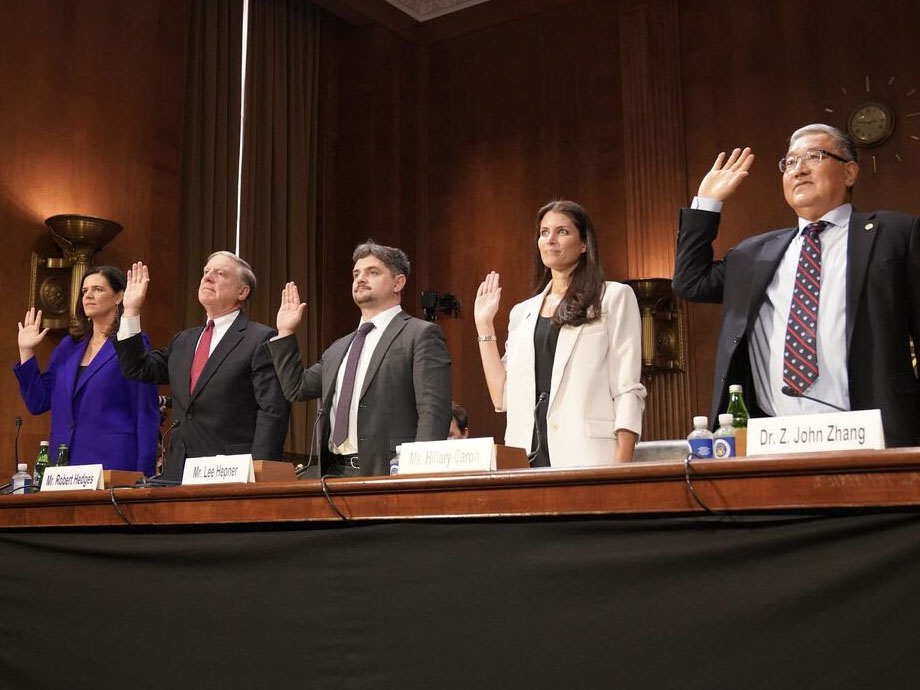
Led by Senators Josh Hawley (R-Mo.) and Dick Durbin (D-Ill.), the Senate Judiciary Subcommittee on Crime and Counterterrorism recently heard testimony from industry leaders and consumer advocates on the spread of AI-driven technology, including UFCW’s Policy Counsel Hillary Caron.
At the August 4 hearing, titled “Your Data, Their Profit: The Consumer Cost of AI Surveillance Pricing,” Caron outlined the damaging effects of surveillance pricing and electronic shelf labels (ESLs) on consumers and workers in grocery stores. ESLs enable retailers to change prices instantaneously, and corporations are racing to deploy them. Walmart, for example, plans to replace traditional paper price tags with digital ones across all of its stores by the end of 2026. The corporation also recently secured patents to use shoppers’ personal data to update prices at scale.
“On their own, ESLs are merely a piece of hardware to display prices. The problem is that they are not used on their own. They are connected to stores’ inventory systems, point-of-sale systems, and pricing systems, which use consumer data and AI to set prices in a way that maximizes profits. They can even be connected to cameras and sensors that track you as you move through the store, capturing how long you look at an item and showing you personalized ads.
“Groceries are a necessity, not a luxury. Companies should not be able to use your online history, past purchases, or location information to charge you a higher price for the food your family needs to live.”
The technology isn’t popular with consumers, either. A recent poll found that 65 percent of American voters believe ESLs will drive grocery prices up, and 68 percent think the same of surveillance pricing. Sixty-seven percent of voters favor banning this technology and these practices in grocery stores, with support cutting across party lines. Seventy-two percent of respondents said they do not have faith in grocery stores to use this technology responsibly.
Last month, New Jersey Governor Mikie Sherrill signed the Fair Price Protection Act — the nation’s first moratorium on ESLs and ban on surveillance pricing in grocery stores — into law. New Jersey is among 12 states that have joined UFCW’s “Affordable Groceries and Good Jobs Campaign” to ban the predatory practice of surveillance pricing, target the encroachment of AI-driven technology in grocery stores, and deliver fair prices for families while preserving good, union grocery jobs.